Building Out From the Megadungeon or Just in Time Prep
Introduction
If you've read many of my posts, or interacted with me much online you've probably gathered that I'm an inveterate procrastinator. This extends to my game prep. Unless I've got an idea bursting out of my head or I need it for tomorrow's game, it's probably not getting done right now. This has made me a very good improvisational referee, which has benefits and drawbacks. In response to a recent blog post about my Thracia game my friend Maya asked:
I'm curious, how are you framing Caverns of Thracia? Is there anything special about your players' hub town? Did you put anything outside the dungeon? Buying equipment and starting at the dungeon entrance works with a megadungeon, but ive been thinking about making a small locale around it.
This post is an elaboration of my response, but the outline is essentially:
- What do I need before we start playing?
- What basic maintenance needs to happen between sessions.
- What does it look like when the party leaves the adventure site?
- How does the party interact with the wider world?
Before the Campaign
Caverns of Thracia is a megadungeon, and the intention of a megadungeon campaign is to focus on the dungeon! Of course the party will be spending most session time in the dungeon so prep should support this. I talk a bit about why I'm running Thracia in my Week 1 session report, but suffice to say it's a true classic and one of the most influential modules ever written. It was also remastered and re-released last year by Goodman Games, so luckily for me I don't have to write a whole megadungeon.
If someone were looking to run a megadungeon of their own devising general consensus is to start with 3 levels and add as needed. There's a very good chance you could run for years without needing any more than that. What I needed to do before starting was:
- Read the module, focusing on the entrances and the first level.
- Decide on a system to run it in.
- Write up any setting stuff that isn't covered by or contradicts that system.
- Work out any house rules and share them with the group.
My group decided on Shadowdark, which works really well for Thracia right off the bat. All I did was come up with a Pantheon (I'm a sucker for a pantheon) that fit the tone of the setting. I also tweaked the spellcasting rules1.
Session 1 went off well for the most part. I started the group at the edge of the ruined city, in sight of some structures that his entrances to the caverns below. They didn't need to know anything about the world beyond the dungeon, it wasn't relevant to this session. I believe this helped them focus on what they were here to do: go die in a hole.
After Session 1
My biggest complaint with myself was over-reliance on read aloud text from the room descriptions. I was running high on adrenaline, and trying to keep the pace up so instead of reading ahead and distilling information for the group I just read the italics out loud and went from there. Unfortunately this "box text" didn't take into account what was visible to the PCs from the entry point of a room, and in some cases gave too much information rather than baiting juicy hooks for the PCs to bite at. So in prepping for my next session I re-read the rooms they were most likely to see, keeping the range of their lantern and DIY & Dragons' essential Landmark, Hidden, Secret paradigm at the front of my brain.
I also wanted to give myself more tools for dynamic conflict, so I started expanding Cavern denizen stat blocks using Warren from I Cast Light's Punnett Squares for Monster Design. Again, I only need to worry about enemies that appear in large numbers, and on the surface or the first two levels, the party isn't going to see anything else anytime soon. For individual monsters/foes I feel confident in my ability to convert them from DCC on the fly, because I'm good like that.
Outside the megadungeon
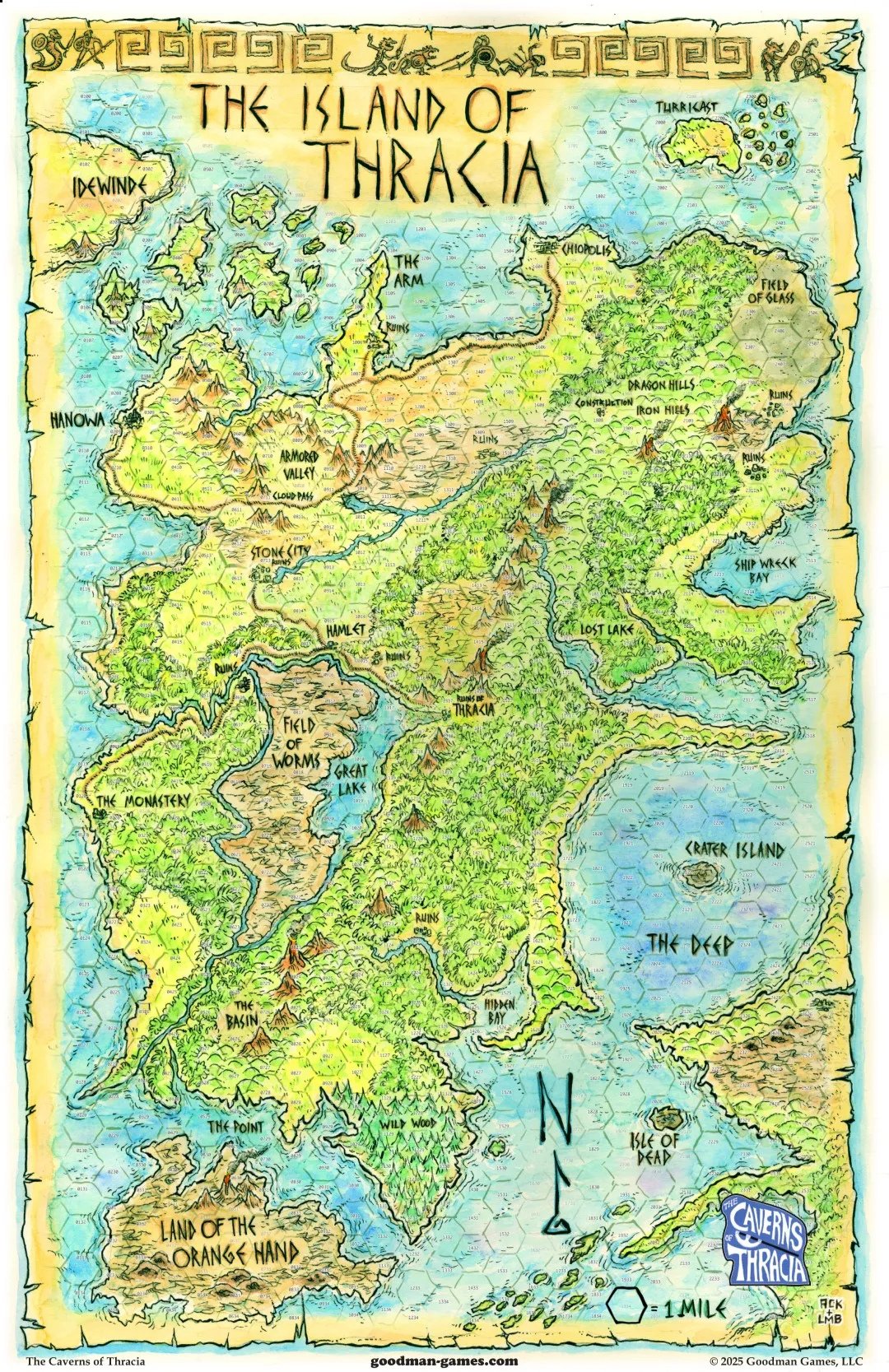
Most megadungeons come equipped with a kind of base camp. A place where the PCs can rest, acquire supplies (often at an inflated rate), heal up, hire porters and torchbearers, and maybe sell some loot (at depressed prices). For Thracia, as presented in both Jenell Jaquays original and the Remastered version there isn't a settlement specified. One of the OAR: Caverns of Thracia Kickstarter add ons was a booklet called The Lost Lore of Thracia which includes a poster hexmap and key of the Island of Thracia. One of the hexes contains a hamlet 4 miles from the ruined city:
This unnamed hamlet is made up of several clans of humans (treat as a mixture of bandits, man-at-arms, and peasants – see p. 423-434, DCC RPG), with a total population of about 50 individuals. Modern Thracian is the primary language spoken here, although a few residents also speak Common. The residents of the hamlet are relatively self-sufficient, taking what they need from the river or growing their own crops on farmland claimed from the jungle. Occasionally, a small mission ventures to Hanowa to trade for something they can’t produce themselves, such as metal tools or weapons. These residents travel along the old trail north to where it disappears just south of Stone City, then head to the western side of the mountains in the north, eventually meeting up with the Long Rong between Hanowa and Chiopolis. This journey is so seldom made, however, that an established trail has yet to be worn down.
Most of the hamlet’s citizens are vaguely aware of the ruins to the east (hex 1015) and west (hex 0616), as well as the location of the ruins of Thracia (hex 1317). They are a superstitious lot, however, and tend to avoid these places.
There are is also some context in the main text. To summarize:
- The Thracian descendants speak the Modern Thracian language, a handful of them also speak common to aid trading at the nearby port city of Hanowa.
- They hate and fear the beastmen who capture them for food, sport, and slaves.
- The Cult of The Dark One (Thanatos) capture occasional Descendants in order to offer them as sacrifice.
- Because of this, Descendants are slow to trust outsiders. Any sign that someone is a follower of Thanatos leads to instant hostility and attack from the tribes.
- Some amongst the tribes are secretly members of the death cult.
So, here's what I've got for the hamlet Koinonia
- They are distrustful, only a few of them know Common. Occasionally they send an expedition to trade in Hanowa on market days.
- They only have a smattering of goods for trade/sale, all at double price: torch, rope, rations, sack, club, staff, spear, arrows, short bow. Arrows and spear will be tipped with flint and deal -1 dmg.
- Strangers in good standing will be fed and given the use of a tent near the center of the hamlet. The villagers will become impatient providing this hospitality if not shown reciprocity, 3sp per person, gifts of trade goods, or exchanges of work would suffice.
- Matriarch Iomene - Short, shrewd, smiles at children.
- Alector the Trader - Warm, broad shouldered, walks with a limp, speaks common.
- Lydus the Haruspex - White maned, disinterested, petty magics, soothsaying, and potion making.
- Rhene the Hunter - Lithe, quiet, observant, speaks common.2
Drawing the Rest of the Owl
Eventually my players will need to venture out into the wider world where they'll sell loot, buy better equipment, pass time during downtime actions like carousing and research, encounter factions, and potentially travel to other parts of the island and archipelago. To that end, over the coming weeks and months I'll need to write up
- A calendar to track passage of time, mark important events, and monitor long term schemes and projects.
- An expanded the port city of Hanowa[^3] to include locations, NPCs, and factions for the party to entangle themselves in. The extent of those entanglements will have to be carefully balanced, because I do want to keep the game focused on the dungeon. (Lost Lore of Thracia has this to say about Hanowa).
As the major port of this region, the city of Hanowa is built along the coast, with most of its commercial enterprises taking place not far from the docks and only residential areas located further inland. Smiths and craftspeople of all types can be found in Hanowa. The city has no wall to the east, but there has been recent talk about building one. Despite its proximity to Idewinde, Hanowa is a relatively safe place with a low crime rate. Except for exotic mounts those that cost more than 75 gp), most mundane equipment can be purchased here.
- I'll also be adding a couple more villages near the ruined city, Kome and Apoikia. Mostly in order to satisfy my own feelings about demographics, but it should also give the opportunity for more politicking and quest hooks.
- Shortly after the party returns to "civilization" with a decent haul of treasure they'll have to start contending with rival adventurers.
- Together as a group we'll have to discuss the extent to which we use the details from the map of The Island of Thracia to expand available shenanigans. It's such a fun map and hex key that it would be a shame to waste the opportunity to use it...
Conclusion
Doing all the legwork is fine, and observing Blorb principles can be useful, but don't let anyone convince you that they're the only viable or good approaches to preparing your campaign world. Leaving world elements to be established until I need them means that I give myself (and my players!) more space at the table for improvisation without obviating work I've already done. Crucially, it also lets me be lazy while still having a perfectly fun and complete game experience every other week.
Feel free to drop me a line and discuss this post on Bluesky.
I'm using a variation of Mike Shea's spellcasting rules for Shadowdark that Kelsey Dionne featured in a one-shot I played at PAGE this year. In case you're wondering, Kelsey runs a really good game.↩
I found this document with a bunch of ancient Greek names. Great resource for NPCs↩